“The Riemann hypothesis has been solved”! (albeit unverified)
That’s the last thing I read before going to bed amidst a bleeding portfolio btw. Took my attention away from my portfolio for a bit as I kept thinking about how the world will never be the same again.
Just six years ago, the entire world got shut down, life was bleak, people envisioned the end of humanity…I for one was not so against the world ending anyway, didn’t have so much going well for me at the time. We survived, though. And through all of that, it would have been impossible to predict how vastly the world was going to change in the emerging decade.
"There are decades where nothing happens; and there are weeks where decades happen" - Vladimir Lenin
The pace of development since GPT-2 said “Hello world” in 2019 has been astronomical. It felt like we had leaped into the future, with a ripple effect that has been felt across every field, sparing none — Software Engineering, Mathematics, Biology, Physics etc. We’ve seen Artificial Intelligence make astronomical progress in these fields that would have been considered impossible 6 years ago.
If you’re like me, you’ve probably spiraled in-and-out of depression trying to keep up with the pace of improvement. Every other day you come across floating doomsday thinkpiece citing how humans would become second class citizens, lose their livelihood to AI and possibly even their lives one day if the field of AI safety can’t keep up with this insanity.
Spoken with tons of people, and everybody shares the same concerns of not knowing what to do anymore, nor how to prepare for this new golden age or perhaps techno-dystopia we’re being forced into. Spent months thinking about it, and the answer hit me like crack this morning:
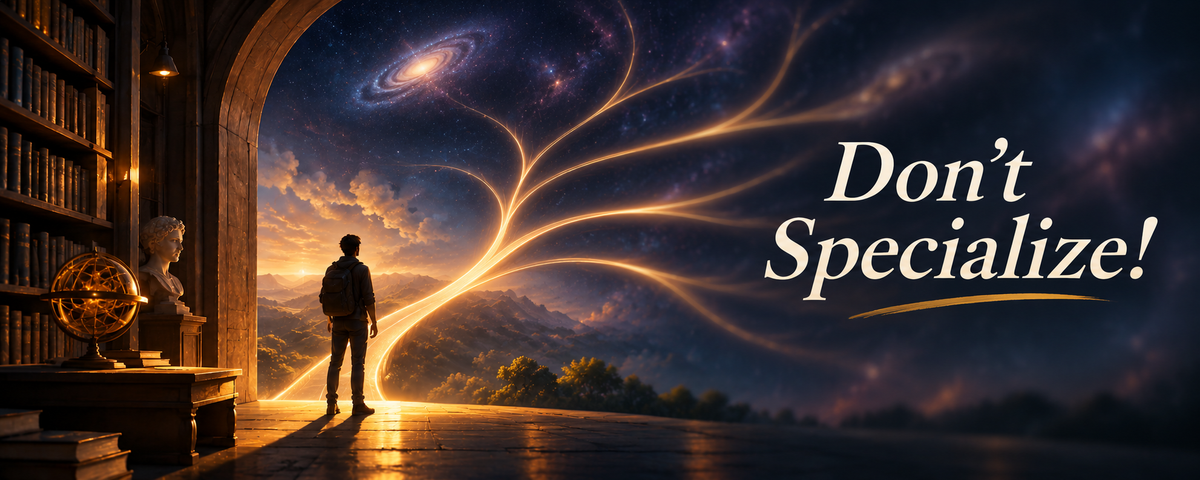
“Don’t specialize!”
I grew up hearing/reading about Polymaths — people who had been able to conquer multiple fields, a seemingly impossible ambition for the very reason that conquering one field could take up more than half of one’s lifetime, let alone two ... .at least until now.
In just a couple centuries, humanity has gone from times where even the most curious minds were constrained by the amount of knowledge they could obtain, to a point where the average joe now has more intelligence at his fingertips than Leonardo Da Vinci had across his lifetime.
In a world where intelligence becomes so accessible, the differentiating factor becomes how much of that intelligence we’re able to utilize, and utilizing Intelligence begins with knowing to ask the right questions..
Two people could have access to the same model, the same wealth of knowledge, yet achieve widely different results, because one knew how to ask the right questions, the other didn’t. But asking the right questions requires knowledge. Take the mathematician who recently claimed to have solved the Riemann hypothesis with Claude. What separates him from me isn't access to the model, it's years of mathematical training. An experience that teaches you what questions to ask, which approaches are worth exploring, and how to assess the answers, and this can also be seen across multiple other fields.
A novice might ask “Hey Claude, design a robot for me”, but an experienced roboticist would rather ask how to trade off actuator torque, energy consumption, thermal limits, battery mass, mechanical stability and manufacturing cost under specific operating conditions.
The second question is more useful because the person has a better understanding of how robots work.
Now imagine what becomes possible when depth of knowledge is combined with breadth across several other disciplines. You begin to see problems from perspectives that might never occur to someone working entirely within one field.
For example, take a mathematician who understands genetics, or a doctor who can also write software. Their advantage lies not in the fact that they know better than specialists in each field but rather that they understand both fields sufficiently enough to draw lines and connect dots others cannot.
I strongly believe that some of the most exciting breakthroughs of the coming decades will come from people willing to make those connections. History is filled so many such cases:
- Combining physics, botany, and instrument engineering, Jagadish Chandra invented the crescograph and investigated electrical responses in plants alongside early radio and microwave research.
- By blending optics, geometry, astronomy, and psychology in his Book of Optics, Ibn al-Haytham challenged earlier emission models and showed that light travels in straight lines into the eye.
And many more.
Though it's important to distinguish between shallow generalists and the model of interdisciplinary thinking I’m proposing. The best interdisciplinary thinkers usually have a specialized field where they have depth. Combining that depth with a breadth of knowledge across multiple other fields is what opens the kind of intellectual doors described in this piece.
I've always thought that part of humanity's ingenuity lies in our unpredictability. The ability to create our own goals, pursue our own meanings and explore unimaginable physical, intellectual and philosophical territories. But for most of human history, curiosity has been constrained by the enormous cost of acquiring knowledge. We could spend a lifetime mastering one discipline and still barely scratch the surface of another.
AI has begun to change that.
The needs for specialized expertise would never be eliminated, and AI won’t give you expertise overnight, but it has certainly unlocked something previous generations never had:
The freedom to explore unfamiliar intellectual territories without having to spend years finding your way in. An opportunity, not to know everything, but to become curious enough to venture beyond what we already know and explore impossibilities!
So my friend, if there’s any advice I’d leave you with, it’s this:
“Don’t specialize your curiosity!”